DustedSeed deck · September 2026
Bet on yourself.
Play familiar games live against friends and rivals for real money.
$5 Blocks. Ninety seconds. Winner takes $9.

01What every game has in common
Cards, dice, pool, darts, dominoes, poker. Nobody had to be taught that a stake makes a game matter; it was there before the rules were written down.
Cards
Money
Dice
Money
Pool
Money
Darts
Money
Dominoes
Money
Poker
Money
Games on
your phone
Nothing
3.1 billion people play games on a phone.[S5] Almost none of them can play a friend for five dollars.
02The $5 round
Both enter for $5. Same live match. Winner takes $9, Dusted keeps $1, and the result becomes a replay, a rematch and a rivalry record.
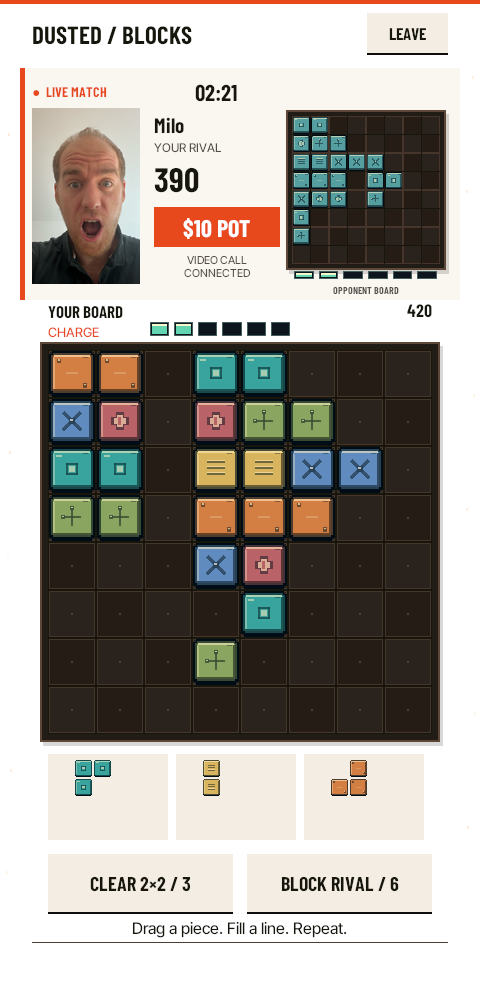 Dusted Blocks · live match screen
Why this is new · three things no phone game does today
Two friends, $5 each, on one round of a game they already play. Winner takes $9. No phone game lets two friends put money on each other.
On screen · $10 POT
Same board, same clock, both of you playing now. Skillz, Papaya and every other cash game on a phone are asynchronous: their players play alone and get compared to a stranger afterwards.
On screen · LIVE MATCH · OPPONENT BOARD
Face and voice on by default with friends. Off by default with strangers; the board is always shared.
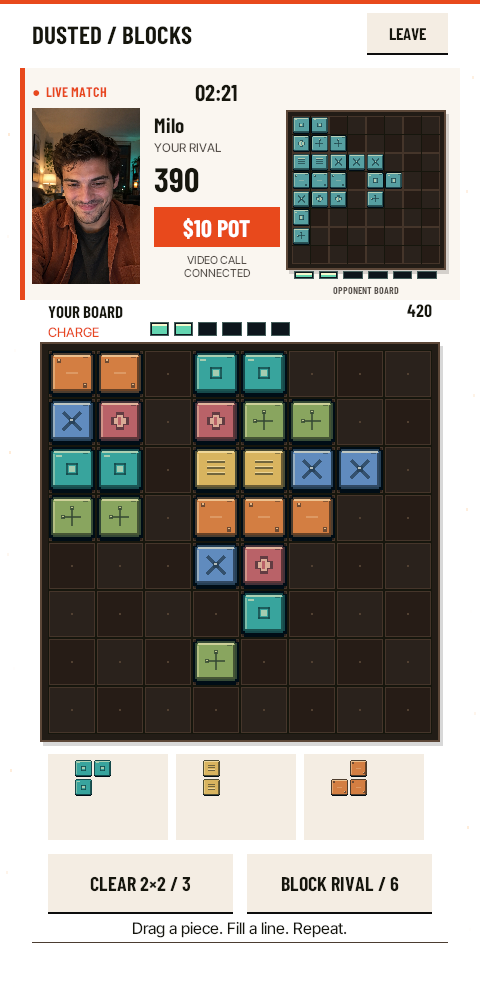
On screen · Milo, on camera · Video call connected
Beating your friend for nothing is a Tuesday. Beating him for $5 of his money is a story.
Practice, friendlies and clubs are free. Playing for money is optional and it is the only thing we charge for.
03Who plays Dusted?
Wagering-native · US · reported figures, marks belong to their owners
Kalshi
$37bn tradedAug 2026
Event contracts, one month
Polymarket
$8bn tradedAug 2026
From under $5bn a month combined a year earlier
Robinhood
13.6bn event contractsQ2 2026
10× in a year
DraftKings · FanDuel
$167bn stakedFY2025
52% of US men 18 to 49 hold an account
Skillz
$542m entry feesFY2025
Solo scores compared later; nobody present
Every one of them is betting on somebody else
Competition-native · third-party titles, reported figures, marks belong to their owners
Block Blast
300m monthly players
Alone, against nobody
8 Ball Pool
1bn+ downloads
Coin matches, no cash
Stumble Guys
~600m downloads
Live, 32 players, nothing on it
Golf Clash
$789m revenue
Head-to-head, coins only
Mario Kart
87m units
Friends on a sofa, no stake
Every one of them competes on their own skill, for nothing
First customer
Second customer
A $5 contest needs no explaining to either group.[S1, S4, S8, S17, S20, S21, S36, S41, S42]
04The games
Each one an original build, on the same identity, wallet and rival graph. The figures are what the reference title has already reached.
Format reference · third-party titles, reported figures · marks belong to their owners
Blocks
300m monthly playersBlock Blast
Same seeded board, two players, ninety seconds
Pool
1bn+ downloads8 Ball Pool
Live 1v1, prototype built
Bubble
Cash competition provenBubble Cash
Same board, first to clear
Knockout
~600m downloadsStumble Guys
Up to 32, last one standing
Racing
87m unitsMario Kart
Kart racer prototype built
Golf
$789m revenueGolf Clash
Head-to-head, one hole
Falling block
500m+ unitsTetris
Two wells, one seed
Party
21m unitsMario Party
Minigames, club night
One competition layer over every format
Named for format identification only; no affiliation implied. Formats are not protectable, expression is, and every Dusted game is our own.[S6, S17, S20, S21, S24, S25, S27, S36] Full landscape in A3.
05How Dusted gets its first players
Challenge · via link · $5 Blocks
Same board. Ninety seconds. Winner takes $9.
Accept · $5FRIENDS COMPETITIONS
A challenge link opens straight into a $5 match against someone you know. The loser gets a replay and a rematch button. Group chats, offices and alumni groups run a weekly club night with one bracket and one pot. A prize is a rented user. A rival is an owned one.
 markus_plays
 tomo · from chat
markus_plays ✓
Losing $5 to my own chat on Dusted Blocks · challenge link below · loser pays
STREAM CHAT
brk_ he lost AGAIN 💀
tomo that's $15 tonight lmao
lina.k REMATCH
dvs put $20 on it coward
mod challenge link in the description ↓
brk_ chat vs streamer next??
nia__ i'm next, $5, same board
tomo ez money
SOCIAL MEDIA
Streamers challenge their chat and lose $5 on camera. Creator tournaments with one pot. Every result is a shareable card with the replay attached. Twitch, TikTok and YouTube do the distribution; we pay creators for a first paid match, not an install.
Where the clips travel · third-party platforms, marks belong to their owners
Twitch
Streamer vs chat · live
YouTube
Full matches · Shorts
TikTok
The 20-second clip
Kick
Streamer vs chat · live
PAID
Sports-betting, prediction-market, poker and fantasy audiences in permitted US states, age-gated. Channel eligibility is confirmed during launch clearance, not assumed.
AFFILIATES
Prediction-market, poker and pool creators and newsletters, paid on a first completed paid match.
PROMOTIONS
First-match credits and creator tournaments to fill matches at launch; promotional entries reported separately from deposits.
Paid acquisition will be expensive. The bet is that challenges, rematches and clips lower the blended cost over time; the pilot measures whether they do. Model in A5, gates in A12.
06Competition
Live · casual
Dusted
Your opponent is present. Two minutes to understand. Friends before money.
Live · core
Real competition, for people who already take gaming seriously.
Asynchronous · casual
You compare scores with a stranger. Nobody is actually there.
Asynchronous · core
Infrastructure, not a consumer product.
Skillz proved people pay to compete: $2.44bn of entries in 2021. Its players competed alone against strangers' scores; when the bonus cash stopped, its paying base fell from 610,000 to 110,000.[S8, S28] History in A4.
07Team
Markus
Maier
Founder
LinkedIn ↗Built and sold a venture-backed consumer company. Built Dusted's multiplayer prototypes and competition rails himself.
Built & sold
Nudge, sold 2026Backed by Balderton, Coinbase, Brevan Howard
Product
Amazon Prime Video, Senior Product Manager
Operated
Axel Springer SE, Chief of Staff
Trained
Harvard Business School · Bridgewater · HV Capital
First senior hire
A founding game director who has shipped and operated successful multiplayer games. Month one, founding equity. Full hiring plan in A10.
08The ask
€4.0m
Customer acquisition. Paid, affiliates, creators, promotions, creative.
€1.3m
Game and product team. One excellent launch game, lean and senior.
€0.7m
Competition rails, integrity, anti-fraud.
€0.6m
Legal, payments, compliance, market clearance.
€0.4m
Infrastructure, G&A, contingency.
STAGE 1
Creative and channel tests at small budgets.
STAGE 2
Only after legal clearance and acceptable retention.
STAGE 3
Only after contribution economics and challenge-led acquisition show promise.
Why the team stays small
AI lets us prototype mechanics faster, produce far more ad creative, test formats cheaply and keep the permanent team lean. That is why 57% of the round goes to distribution, not headcount. Headcount follows evidence. Unit economics in A5, trust and permissions in A13, vendor claims in A9.

Familiar games. Human opponents. Real stakes.
AAppendix
Sources, legal analysis, model assumptions, integrity proofs and the hiring plan. Collapsed on purpose.
Two unreleased prototypes and one set of competition rails. Verified 14 September 2026 on a clean checkout.[P1]
138
Pool prototype tests passing: 39 simulation, 51 rules, 48 server integration. Two real accounts matched and played one live table over two WebSockets, one agreed result and a replay id.
Built
10,000
Generated shots reproduced bit-exactly across two independent simulation instances. The simulation contains no floating-point arithmetic.
Built
20/20
Cash-integrity attacks refused by the server from a hostile client: score injection, out-of-turn shots, frame replay, forged and expired tickets, seat theft, flooding.
Built
17/17
Kart racer backend tests: ledger, idempotency, settlement, security, five e2e multiplayer scenarios. Eight networked clients in one authoritative race; escrow reconciled to zero; kill the server mid-race and it voids and refunds exactly once.
Built
Also measured and reported whether or not it flatters us. Pool fairness on the final table geometry: first breaker wins 50.74% over 14,400 matches, inside the acceptance band — and still no-go for cash until an unexplained between-batch dispersion is understood. A shot-selection solver held to human aim error is a coin flip against a strong scripted player; given perfect aim it wins 95%. Automated aim input is the threat that matters, and it is why cash limits will be governed by attestation, not by the shot clock.
Brand
The place competition happens
Games
Owned, original, and the reason to arrive
Social graph
Friends and rivals — the reason to stay
Competition liquidity
Fair matches that fill instantly, at any hour
Player reputation
Rating and history worth not abandoning
Integrity data
Years of match telemetry a newcomer does not have
Developer distribution
Access to a competing audience already assembled
Why game five is easier than game one
Every new title inherits accounts, payments, matchmaking, anti-cheat, the social graph, clubs, tournaments — and an existing population of players to fill its matches on day one. The first game has to find its own audience. The fifth does not.
| Channel | Status | Implication |
|---|---|---|
| Meta DE/UK/US | Conditional | Cash-prize skill formats need authorisation and established lawfulness. A channel to apply for, not approved distribution.[S9] |
| TikTok Germany | Excluded | Prohibited outright. Removed from the base case.[S10] |
| TikTok UK / US | UK path · US unclear | UK lists skill games with money-out. The US example says free. Treated as unavailable until confirmed.[S10] |
| Apple | Conditional | Licensing, geo-restriction, free app — and IAP cannot fund real-money play, which dictates the wallet architecture. The Epic injunction currently bars Apple from taking commission on external payment links in the US, which makes web deposit cheaper than it has ever been — and is still under appeal, so we do not underwrite a zero Apple take.[S11, S33] |
| Google Play | Excluded | Prohibited outright, not merely restricted. Play does not allow "content or services that enable or facilitate users' ability to wager, stake, or participate using real money … to obtain a prize of real world monetary value", and cites as a violation "games that accept money in exchange for an opportunity to win a physical or monetary prize." The licensed exceptions are casino, sports betting, horse racing, lotteries and daily fantasy — skill-cash tournaments are not among them.[S12] |
| Steam / consoles | Excluded | No verified path. Out of the base case entirely.[S13] |
The consequence, stated plainly
This is an iOS-first business, possibly an iOS-only one. Google Play currently excludes the format outright and Android is roughly seven in ten of the world’s phones; Solitaire Cash has stayed on the App Store while disappearing from Google Play.[S12, S29] Read every audience figure here as iOS users in a cleared territory, not as adults with a smartphone. The sideload and alternative-store routes opened by the EU Digital Markets Act are a possibility to test, not a plan to fund.
Legal permission and platform permission are separate gates. No legal opinion is offered here: classification depends on consideration, prize value, the role of chance, player location, age, custody and payment flows, and “mostly skill” is not an exemption anywhere. Germany’s statutory test turns on whether the outcome depends predominantly on chance,[S15] so adding randomness to frustrate bots moves that analysis the wrong way. The on-point precedent is Michigan: in October 2024 the Gaming Control Board issued a cease-and-desist finding that 21 Cash, Bingo Cash, Bubble Cash and Solitaire Cash constitute illegal gambling under state law.[S34] A “skill game” label did not survive contact with a state regulator. Two risk vectors are easily conflated: the 2025–26 rulings that declared cash-entry products unlawful (Pennsylvania, Missouri) concern physical terminals, not mobile apps, so the read-across is doctrinal rather than binding, while the live exposure for a mobile operator has run through false advertising and consumer protection.[S29, S35] Both are real; we do not plan for them the same way. Before any paid entry: jurisdiction-specific advice, operating permissions, payments acceptance, age and identity verification, geolocation, fund-handling and withdrawal terms, tax treatment, written Meta classification. Today every one of those is open.
And a category can be switched off. India’s Promotion and Regulation of Online Gaming Act 2025 banned real-money online games outright in August 2025; Dream11, MPL, Zupee and WinZO suspended paid contests within days, and the ban removed 95% of Dream Sports’ revenue.[S32] That is not a prediction about Germany or the United States. It is the reason this round buys written permission in one market rather than scale across many.
The default payment rail refuses this business model, everywhere. Stripe's restricted-businesses list places under prohibited: "Games of skill including video game and mobile game tournaments or competitions, darts, card games and board games with a monetary or material prize." We checked three locale editions of that list — default, United Kingdom and Australia — and found no country carve-out in any of them.[S38]
This holds regardless of whether the activity is lawful in a given market: the operator must be underwritten by a specialist gaming-payments processor rather than a general one — higher fees, real underwriting diligence, longer integration. We treat it as a funded work item in the permission gate. Whether PayPal and Adyen take the same position could not be verified. Open
| Market | Status | Basis |
|---|---|---|
| United States | Open, ~45 states | Predominance test in most states. Cash entry disabled in AR, CT, DE, LA, SD per the incumbent's current terms; SC, MD and MI apply a stricter wager-focused test. Our first market. |
| United Kingdom | Open via licence | Gambling Act 2005 s.6(2) treats chance plus skill as a game of chance regardless of proportion; the s.14 prize-competition exemption is narrow. Realistically a licence application, not an exemption. |
| Netherlands | Promising | Wet op de kansspelen Art. 1 turns on overwegende invloed — whether participants lack predominant influence. A genuine predominance test. Needs Dutch counsel before we call it open. |
| Australia | Unresolved | Interactive Gambling Act 2001 contains an "excluded gaming service" section whose operative text we could not retrieve. Largest unresolved English-language market; worth real diligence spend. |
| Malta | Licensable | The only purpose-built Controlled Skill Games regime, 5% tax on gaming revenue. Does not passport — there is no EU mutual recognition for gambling, and the e-Commerce Directive's country-of-origin rule excludes it. |
| Germany | Adverse | Federal administrative-court authority holds an entry fee escapes gambling consideration only where it covers organiser costs, not where it funds the prize. A rake model is the case that fails it. § 284 StGB is criminal. |
| Canada | Closed | Criminal Code s.206(1)(f) captures mixed chance-and-skill for money with no predominance safe harbour; Ontario enforcing against skill-marketed machines through 2025. |
| South Africa | Closed | National Gambling Act 7 of 2004 s.5(1)(a)(ii): a game qualifies whether the result is determined by skill, chance, or both. Skill alone is still a licensable gambling game. |
| India | Banned | Promotion and Regulation of Online Gaming Act 2025. The ban removed 95% of the largest operator's revenue.[S32] |
| China, Indonesia, Turkey, Vietnam, Mexico | Closed | Prohibition, state monopoly, or — in Mexico's case — an explicit payment-processor exclusion naming this exact model. |
We are deliberately not publishing a green map. Of roughly twenty markets assessed, only a handful have been taken back to a primary statutory source; Ireland, Japan, South Korea, Singapore, Israel, Poland, Austria, Belgium, Spain, Portugal and most of Latin America remain genuinely unresearched. A market is listed above only where we have a basis. The plan funds one market properly rather than claiming many.
The format, yes. The expression, no. US courts have said it plainly — "game mechanics and the rules are not entitled to protection" (Tetris Holding v. Xio, 2012).[S25] Art, characters, names, levels and trade dress are protected: Xio lost because its clone was "all but indistinguishable", and the court noted it had "limitless options" to build the same-functioning game lawfully. The category runs on this — Stumble Guys cloned Fall Guys to 600m downloads.[S17]
The real exposure is patents, not copyright. Nintendo and The Pokémon Company sued Palworld's developer in 2024 over three Japanese patents on a creature-catching mechanic — not over art. Damages sought: about $66,000.[S26] Our rule: original art and audio from day one (already true — A7), freedom-to-operate review per format, and no mechanic that reads as someone's patent. Not legal advice.
Every format below is short, thumb-playable, understood in ten seconds, and ends in a clean finishing order. We build originals of them, one at a time, on one competition layer. Orange marks the launch game and the next one.
| Format | Status | Reference title — reported scale |
|---|---|---|
| Block duel | Launch game | Block Blast · 300m MAU |
| Pool | Next · prototype built | 8 Ball Pool · 1bn+ downloads |
| Bubble duel | Lined up | Bubble Cash · cash-competition proven |
| Knockout | Lined up | Fall Guys · 50m in two weeks |
| Kart racer | Assessed · prototype built | Mario Kart · 87m |
| Golf duel | Assessed | Golf Clash · $789m |
| Sports duel | Assessed | Wii Sports · 82.8m |
| Falling block | Assessed | Tetris · 500m+ |
| Party minigames | Assessed | Mario Party · 21.2m |
| Platform fighter | Assessed | Smash Bros · 38.1m |
| Arena brawl | Assessed | Brawl Stars · 49.8m/mo |
| Live trivia | Assessed | HQ · 2.4m concurrent |
Third-party titles are named for format identification only. Marks belong to their owners; figures are reported or third-party estimates describing those titles, not Dusted.[S6, S7, S17, S20–S24, S27] Each Dusted game is an original build — no IP, characters, levels or branding used or implied.
Two of these already charge an entry fee. 8 Ball Pool and Golf Clash run coin-entry head-to-head matches every day, with a billion downloads and $789m of revenue between them — the only difference is what the winner is paid in.[S20, S21] One already paid cash. HQ Trivia put real money on a casual game and reached 2.4 million concurrent players, then ceased operations in 2020; its prize pool was funded by investment rather than by a sustainable take on entries.[S22]
The public comparable’s revenue and payer history at its turning points.
| Period | Revenue | Paying MAU | What it shows |
|---|---|---|---|
| FY2020 | $230.1m | n/d | +92%. Category demand is not in question. |
| FY2021 | $384.1m | 610k (Q4) | The peak. S&M $465.5m — 121% of revenue — of which $187.6m was engagement marketing, bonus cash paid to existing players. 49% of revenue. |
| FY2022 | $269.7m | 235k (Q4) | −29%. User-acquisition spend cut 30% in Q1 alone; payers fell with it immediately. Plus $168.1m of impairments writing off the Aarki acquisition. |
| FY2024 | ~$95m | 110k (Q4) | The floor. Payers down 82% from peak. |
| Q2 2026 | $31.0m | 117k | Revenue +23% YoY. Payers still falling. Growth is ad-tech and ARPPU, not players. |
Payer basis: FY2021–FY2024 figures are Q4 point-in-time; FY2025 and the 2026 quarters are as reported for the period. Marked where they differ rather than blended.[S8, S28]
What broke, in one line: they rented the peak. Sales and marketing exceeded revenue every year from 2020 to 2022 and roughly half the 2021 spend was bonus cash. When Apple's ATT change raised the price of buying users and management cut the spending, the paying base fell from 610,000 to 110,000 over three years. Management's own quarterly language attributes the decline to their own marketing cuts, not to market conditions.
And the 2026 recovery is not what it appears. Revenue is growing while paying players keep falling. The growth comes from an AI ad-tech unit, from the Papaya judgment, and from charging a smaller base more per head. The company reorganised and renamed itself Firy Inc. (NYSE: FIRY) in June 2026 — confirm current corporate naming before circulating. Nobody has yet grown this business by growing the number of people who want to play.
What the incumbent proves — and what it doesn't
Skillz reached $2.44bn of entries and ~3.0m monthly players in 2021, so the demand is not in question. By Q2 2026 it was down to 349,000 monthly players — an 88% collapse — while the survivors monetise harder than ever.[S8, S28]
Skillz proved willingness to pay. Its history also shows that money alone does not create a durable network. It was asynchronous: you played alone and your score was compared to a stranger's later. Nobody was present, so the prize was the main reason to open it. Engagement marketing ran at 49% of 2021 revenue, and when the subsidy stopped so did the players.
A shared balance is not a shared graph. Its titles are separate apps, downloaded separately, each with its own pool of opponents; whatever a player builds in one does not travel to the next, so every new title starts its liquidity at zero. Our bet is that live opponents, friends and rivalries can hold what a prize alone could not. That is a bet, not a finding.
The willingness-to-pay question under Block Duel
Block puzzle's audience has been monetised almost entirely by advertising rather than purchases. One widely repeated estimate puts the category leader's lifetime in-app purchases in the tens of thousands of dollars against hundreds of millions of players — but it traces to a single secondary page citing no analytics platform, and we do not treat it as fact.[S36] The defensible reading: enormous habitual engagement, unproven willingness to spend. Paying a small entry fee for a cash payout is a different transaction from buying a booster, and no published data answers whether this audience makes it. That is what the paid pilot exists to test, and it is why Pool, a format with proven cash payers, is the second game rather than a distant one.
US, iOS, permitted states. Pick a scenario; every figure below comes from one assumptions object.
Conservative
$55m
annual gross fees · 308k payers · $150/mo
2.2× the public comparable's 141k payers
Middle
$277m
annual gross fees · 923k payers · $250/mo
6.5× the comparable's payers
Expansion
$1.18bn
annual gross fees · 2.46m payers · $400/mo
17× the comparable's payers
| Metric | Initial hypothesis |
|---|---|
| Cost per iOS install | $3 |
| Install to first paid match | 5% |
| Cost per first-time payer | $60 |
| Monthly entry volume per payer | $150 |
| Gross Dusted fee at 10% | $15.00 |
| Variable costs (payments, fraud, verification) | −$4.50 |
| Monthly contribution per active payer | $10.50 |
| Payer retention | Unknown |
| Organic invitations per payer | Unknown |
| Contribution LTV | Unknown |
At these assumptions Dusted needs about 5.7 paying months to recover a $60 acquisition cost; paying months are not calendar months. Retention and referral are the central economic questions.
556k
Monthly payers
$150
Entries / payer / month
10%
Fee
12
Months
$100m
Annual gross fees
| US bottom-up model — one shared assumptions set | Conservative | Middle | Expansion |
|---|---|---|---|
| Reachable base: US adult iOS casual players in permitted states (to be verified) | 61.5m | 61.5m | 61.5m |
| Share of the reachable base paying monthly assumed | 0.5% | 1.5% | 4.0% |
| Monthly paying players derived | 308k | 923k | 2.46m |
| Monthly entries per payer assumed | $150 | $250 | $400 |
| Annual entry volume (handle, not revenue) | $0.55bn | $2.77bn | $11.81bn |
| Annual gross fees @10% derived | $55m | $277m | $1.18bn |
| Versus the public comparable's payer base (141k) | 2.2× | 6.5× | 17× |
One thing we will not do here is quote a market size for this category, because no honest one exists. The "$40bn global skill gaming market, 52% of it Asia-Pacific" figure that dominates search results comes from report mills, is not reproducible from any company's disclosures, and — decisively — no version of it we could find has been revised for India banning the largest real-money market in that region. Several still forecast Asia-Pacific as the fastest-growing region straight through the window in which it was outlawed. The only audited number in this entire category is the public comp's own: $541.9m of entry fees and $104.5m of revenue in FY2025.[S8, S32] Everything below is built from stated assumptions instead, and should be argued with on those terms.
Context that is deliberately not in the front deck. Stake-adjacent culture is real — roughly two in five American men 18–49 have used crypto, 0DTE contracts are a record 66% of SPX options volume, and Kalshi, Polymarket, PrizePicks and Underdog were valued at about $22bn, $9bn, $2.5bn and $1.2bn in 2025–26.[S2, S3, S39] None of them is a comparable for Dusted: liquidity, regulation, margins and user behaviour differ. They are evidence that people put money on outcomes for fun, nothing more.
Every row is rendered from one assumptions object; the front deck no longer carries the funnel, so the front deck and this table cannot drift apart. The reachable base is built bottom-up there: 260m US adults → 233m in states permitting cash entry → 212m smartphone → 123m iOS (Google Play bars the category) → 61.5m casual players. That last step is the one we have not sourced and it is labelled "to be verified" rather than asserted. Assumptions, not observed audiences or forecasts, and not a claim Dusted captures them. Before this is an investable SAM the first two rows need jurisdiction-specific adult reach and conversion evidence. Germany cannot be counted as reachable simply because Germans play games. We model at roughly a quarter of the only public comp's revenue per payer on purpose — Skillz runs ≈$320 of entries per payer per month at a 19.3% effective take, against our $150 at 10%.[S8]
| Illustrative paying-player month | Conservative | Middle |
|---|---|---|
| Entry volume (handle) | $150 | $250 |
| Gross fees @ 10% | $15.00 | $25.00 |
| Variable costs (30% of revenue; placeholder, no vendor quote) | −$4.50 | −$7.50 |
| Contribution before acquisition | $10.50 | $17.50 |
| Acquisition per new payer ($3.00 iOS CPI at 5% conversion; unverified. Android excluded — Google Play bars the category) | −$60 | −$60 |
| Simple payback (paying months) | 5.7 | 3.4 |
What payment fees do to a $5 match
Entry fees never touch Apple's rails. Apple prohibits in-app purchase from funding real-money play, so there is no 30% store cut on a wager; deposits run on external payment rails, and the Epic injunction currently bars Apple from taking commission on those links in the US.[S11, S33]
A $5 entry is not a $5 transaction. Players fund a balance and entries draw from it, so a fixed per-transaction fee is paid once per deposit and spread across many matches — cents per match.
Only fresh money carries a fee. The comparable discloses that prior winnings are more than 84% of paid entry fees, so about one dollar in six of entry volume is a new deposit.[S37] On $150 of monthly entries that is roughly $25 of deposits, not $150 — on standard card rates about 7% of revenue at $25 deposits and 10% at $10 ones. The fixed per-transaction fee is the entire difference, which makes deposit sizing and bank-transfer rails a product decision, not a finance one. For scale: the comparable's 10-K defines cost of revenue as “third-party payment processing fees, server costs, amortization of developed technology, personnel expenses… hosting expenses” — and that whole line is 12.5% of revenue.[S40] Its revenue rose 12.5% in FY2025 while cost of revenue fell, because GMV fell and payment fees track deposits, not revenue. Our rake is half theirs, so identical rails cost us roughly twice as much as a share of revenue. Both sit inside the 30% variable-cost line above, and next to $60 of acquisition cost per payer neither decides this business. Specialist-processor premium not quoted
Where the revenue actually comes from
Platform revenue is the rake, and the rake can only ever come from net deposits. It is an identity, the same one a poker room or a sportsbook lives by: money in, minus money out, equals what the house keeps. A player who deposits $50 and never withdraws will see that $50 ground through roughly $500 of entries at a 10% fee before it is gone — and generates exactly $50 of revenue whether they play it out over a week or a year.
Round velocity therefore sets the speed, not the total. Playing faster does not create more revenue; it shortens the player's life. This is why we report net deposits alongside entry volume, why entry volume is not a revenue-quality measure, and why the comparable discloses that prior winnings are more than 84% of its total paid entry fees — the same balance circulating while the rake grinds it down.[S37]
One structural point that is easy to miss and changes how every line above should be read. In this model, most entry volume is not new money. The public comp discloses that prior winnings made up more than 84% of total paid-entry fees — meaning roughly one dollar in six of gross entry volume is a fresh deposit, and the rest is the same balance circulating between players while the platform takes a cut of each lap.[S37] That is good for gross volume and unforgiving about churn: when a cohort leaves, it takes the float with it. We therefore report net deposits alongside entry volume from the first pilot, and we do not treat entry volume as a revenue-quality measure.
Sensitivity: at an 8% fee and $9 of variable cost the conservative case pays back in 20 paying months — not a business. The variable line is the first thing to interrogate and we have no vendor quote for it. "Paying months" are not calendar months. No LTV is claimed. From the first pilot we report paid versus promotional entries, net deposits, fees, contribution and cohort retention separately. Our scale-proof target is sales & marketing under 35% of revenue, against the benchmark's 68%.
All Dusted art is original and produced in-house: illustrated scenery, characters and the item atlas generated with recorded prompts and provenance; environment surfaces CC0 (Poly Haven) with verified hashes; Barlow Condensed under the SIL Open Font License; music and effects generated by our own tool. No third-party audio samples, no purchased or scraped game art, nothing from Nintendo or any other publisher. Third-party titles elsewhere in this document are named in type only, solely to identify a format, and the marks remain the property of their owners.
Research cutoff 10 September 2026. Sources support the specific observations attributed to them — never the product, the modelled economics or the build claims. Platform policies must be re-checked before any campaign.
The AI paragraph in section 08 rests on an argument about search cost that stands on its own: prototype cheaply, measure, kill, repeat. The specific vendor capabilities cited in support of it were supplied by the founder and have not been independently verified in this document. Each should be confirmed before it is repeated to an investor:
The argument does not depend on any one of these being true. It depends on the direction of travel in engine tooling, asset generation and creative production, which is observable regardless of vendor. We would rather state that plainly than cite a capability we have not checked.
One excellent launch game and a lean senior team. Headcount follows evidence; nothing below is committed beyond the first hire.
Founding game director
Shipped and operated successful multiplayer games. Owns whether it is fun. Month 1
Multiplayer engineer
Netcode, server-authoritative simulation, one seeded table per match. Month 1
Competition-rails engineer
Matchmaking, ledger, integrity, anti-collusion, anti-multi-accounting. Month 2
Art director
An original look per title. Month 3
Social product designer
Friends, rivals, clubs, rematch, spectating. Month 4
Growth lead
The cleared-market pilot, measured on cost per paying competitor. Month 4
Legal and payments are bought, not hired: specialist gaming counsel and a gaming-payments processor, funded as a line of the round. What the founder de-risks: company and consumer product building, networked infrastructure and settlement, regulatory and payments research, fundraising and hiring. What the game director must de-risk: whether it is fun, depth, progression, live operations, game economy and multiplayer craft.
What the four promises in A13 look like in the prototype. Built claims are reproducible from the repository and describe payment-free software; amounts are from the model.
Same seed
match  7f3a-0912
you    seed 9c1f7a…e07a
friend seed 9c1f7a…e07a
table  identical ✓
One hashed seed manifest per match, published after it ends. Built
Human opponents
paid field
  you      verified human
  lina     verified human
practice
  opponent PRACTICE BOT ◀
Bots exist only in practice and say so. No house bots in paid matches. Labelled Paid rule
Replayable result
replay 83d9…7630
turns re-derived    16 / 16
scores matched      16 / 16
VERDICT  reproducible ✓
A stored match rebuilt from its recorded commands. A tampered replay fails just as loudly. Built
Double-entry ledger
entry   you        −$5.00
entry   friend     −$5.00
escrow  match      +$10.00
payout  winner     −$9.00
fee     dusted     −$1.00
escrow  balance     $0.00 ✓
Every match reconciles to zero. Fee and split shown before entry. Built Amounts
Exact refund
0:41  server killed
0:41  match voided
0:41  refund you    +$5.00
0:41  refund friend +$5.00
0:42  refund again  REJECTED
Kill the server mid-match and it refunds once, never twice. Tested. Built
Collusion and multi-accounting are open problems before launch scale; both need cross-match analysis over a population that does not exist yet. The Papaya and AviaGames records are in A6 and the sources.
What the round has to show, in order. Where a threshold is not yet founder-approved it says so rather than inventing one.
FunGates 1–3
Voluntary unpaid second-round rate among unfamiliar players.
Threshold: to set before pilot
RivalryGates 4–5
Challenge send and acceptance rate; rematch rate after a loss.
Threshold: to set before pilot
RetentionGates 4–5
D7 and D30, rivalry cohort against solo cohort.
Threshold: to set before pilot
ResilienceGates 6–9
Retention after a loss inside an acceptable band of retention after a win.
Threshold: to set before pilot
LiquidityGates 6–9
Share of entries matched within N seconds, measured per pool.
Threshold: to set before pilot
IntegrityGates 6–9
Fraud and dispute rate at pilot scale; paid and promotional entries reported separately.
Threshold: to set before pilot
EconomicsGates 6–9
Contribution-positive cohort; payback in paying months. Model: 5.7 conservative, 3.4 middle.
Threshold: to set before pilot
PermissionGates 6–9
Written legal clearance, written platform classification, payment-processor acceptance, one market.
Threshold: binary · all three in writing
A jury found Papaya liable in April 2026 over undisclosed bot opponents; a court ordered $719m disgorged.[S29] Fairness has to be checkable by a player, a regulator or a court.
Promise 01
Human opponents
In every paid match. Practice bots are labelled.
Promise 02
Identical conditions
Same board, same seed, verifiable after the match.
Promise 03
Replayable results
Every match rebuilds from its commands.
Promise 04
Transparent money
Entry, fee, payout and refund shown before you enter.
LegalRequirement 01
Written legal clearance for the first US jurisdiction.
Status: open
PaymentsRequirement 02
A gaming-payments processor; general processors exclude the category.[S38]
Status: open
DistributionRequirement 03
App Store classification for real-money skill play.[S11, S12]
Status: open
ControlsRequirement 04
Age and location verification before any paid entry.
Status: open
Dusted holds no licences or channel approvals today. Proofs in A11, markets in A2, integrity in A6.